
Modern RF systems demand more from passive components than ever before.
To better understand the impact of embedded-electrode capacitor architecture, multiple organizations independently evaluated Eulex technology in real-world RF applications including filtering, impedance matching, low-noise amplification, and power integrity.
Bird Technologies Evaluation
Bird conducted testing on the 3-Terminal design within a Grounded Coplanar Waveguide (GCPW) design. The GCPW, a common transmission line structure in high-frequency circuits, provided a controlled environment to evaluate the capacitor’s performance as a shunt component. The testing focused on characterizing the insertion loss and stability of the capacitor over a wide frequency range and under varying temperature conditions.
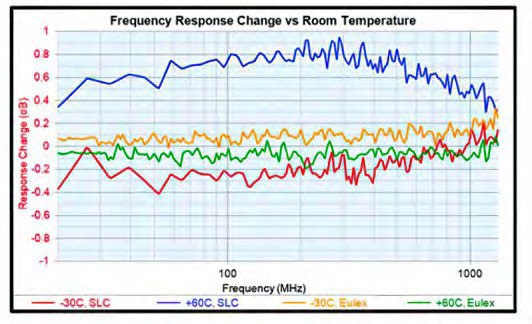
Key outcomes from Bird’s Testing:
•The 3-Terminal exhibited exceptional performance, especially at lower frequencies, wheretraditional capacitors often struggle due to increased impedance.
•The 3-Terminal also showed remarkably stable performance over a wide temperature range, outperforming a standard single layer capacitor in the same GCPW configuration.
“The [3-Terminal design] is our answer to a 5-year search for a better capacitor that has Class 1 stability, high capacitance and great frequency response, allowing us to better meet our specifications over time and temperature.” Martin Dummermuth, Chief Technologist, Bird Technologies
PMI Evaluation
When replacing a conventional capacitor in a low-noise amplifier:
- VSWR improved from 3.3:1 to 2.3:1
- Gain ripple improved from ±2 dB to ±0.5 dB

Filter Performance Improvements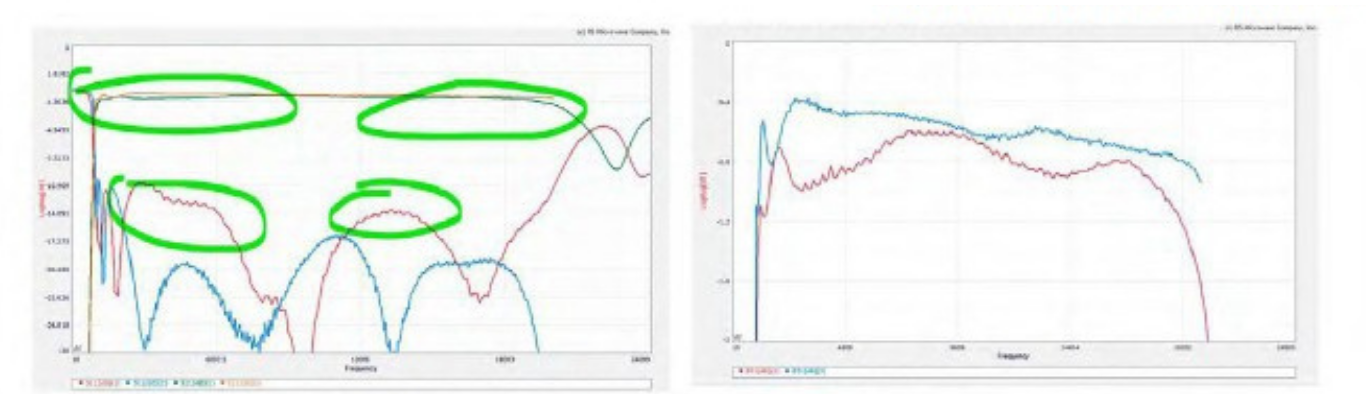
PMI also evaluated the technology in a high-pass filter and observed:
- Return loss improvement from 11 dB to 20 dB
- Improved insertion loss
- Performance maintained to 20 GHz
- Power handling increased from 1 W to 50 W
Note: Fig 1. Orange and Blue - Eulex XG3 Capacitor | Green and Red - SLC
Note: Fig.2 Blue - Eulex XG3 Capacitor | Red - SLC
Picotest ESL Validation
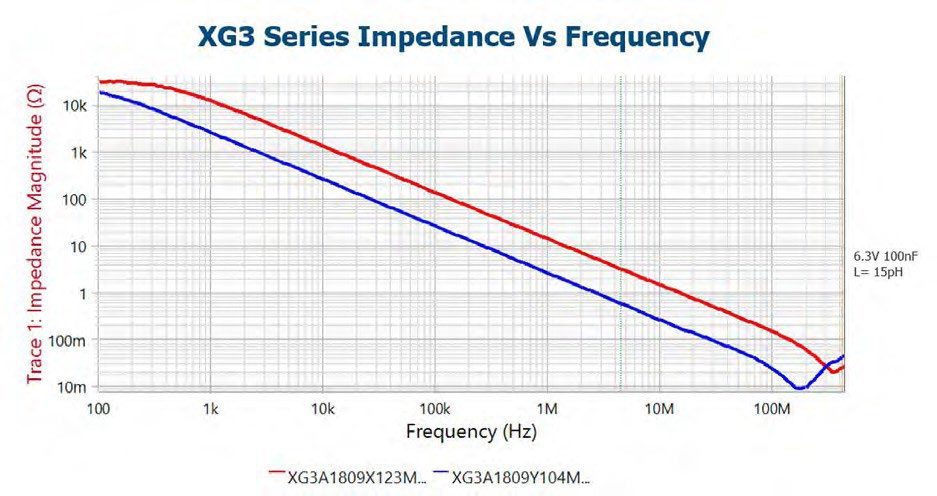
Picotest independently measured inductance and validated ESL as low as 15 pH.
Typical MLCCs are often around 200 pH
What These Results Mean for RF Designers
Independent evaluations demonstrated measurable improvements in impedance matching, filtering, gain flatness, power handling, and ESL performance across a variety of RF applications.
These results highlight the impact that capacitor architecture can have on overall system performance, particularly in applications where parasitic inductance, self-resonant frequency, and broadband RF behavior are critical design considerations.
Key Takeaways
✓ Improved impedance matching
✓ Reduced signal reflection
✓ Improved gain flatness
✓ Lower parasitic effects
✓ Broadband performance beyond 67 GHz
✓ ESL as low as 15 pH
✓ Increased power handling capability
✓ Simplified RF design architectures
The Eulex XG family includes multiple capacitor architectures optimized for different RF and microwave design challenges.
Whether your application requires precision tuning, impedance matching, filtering, decoupling, or power integrity optimization, there is an XG Series solution designed for the task.
Need help identifying the optimal capacitor architecture for your application?
Discuss your RF design requirements directly with the Eulex engineering team.