
High-Frequency Performance for RF and Microwave Systems
As frequencies increase, capacitor performance is no longer defined by capacitance value alone.
Parasitic inductance, ESR, mounting effects, and self-resonant frequency can significantly impact filtering, impedance matching, signal integrity, EMI suppression, and power distribution network stability. In many RF and microwave applications, the capacitor intended to improve performance can become a source of unwanted resonances and impedance variation.
This challenge is becoming increasingly important across phased array radar, electronic warfare, SATCOM, AI infrastructure, RF power amplification, and other high-speed defense and communications systems where stable broadband performance is critical.
The Challenge with Conventional Capacitors
Conventional capacitor technologies often require design tradeoffs between capacitance, self-resonant frequency, mounting inductance, and high-frequency performance.
As operating frequencies rise, these limitations can contribute to:
• Impedance instability across frequency
• Increased RF reflections and mismatch
• Reduced filtering effectiveness
• EMI and noise suppression challenges
• Power integrity issues during fast transient events
• Increased design complexity and tuning requirements
For engineers designing at RF and microwave frequencies, capacitor selection has become a critical system-level design decision.
Designed for Broadband RF Performance
The Eulex XG Series was developed specifically to address the limitations of conventional capacitor technologies.
Built on a patented embedded-electrode architecture, XG capacitors minimize parasitic inductance while delivering stable broadband RF performance across a wide frequency range.
Key Advantages
• Ultra-low ESR and ESL
• High self-resonant frequency performance
• Broadband impedance stability
• Reduced mounting inductance
• Excellent RF filtering and bypass characteristics
• Compact surface-mount package options
• High-reliability construction for demanding environments
The result is improved RF performance, simplified designs, and more stable operation across challenging high-frequency applications.
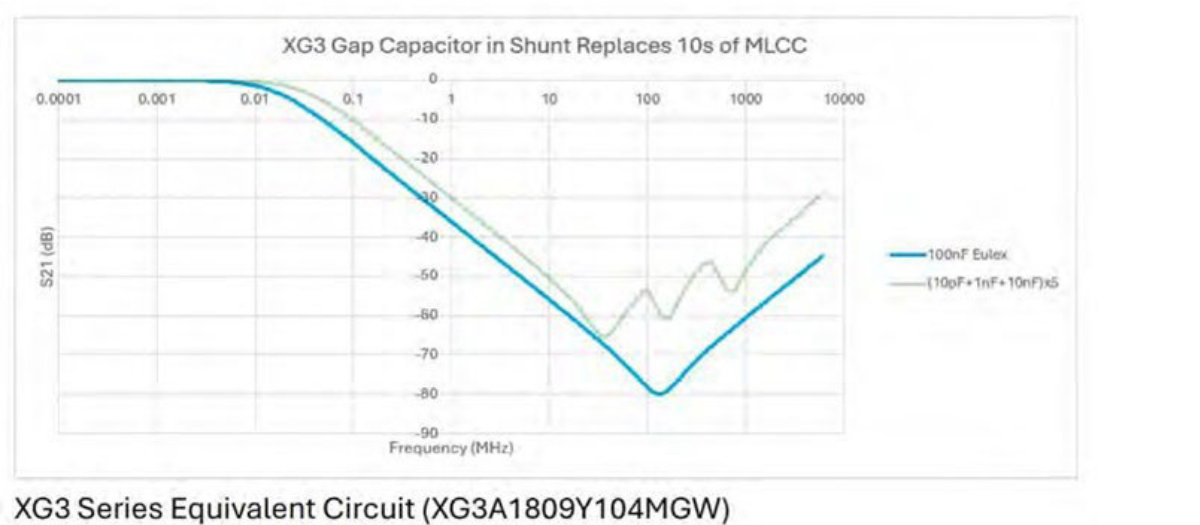
Figure: Broadband RF performance enables a single XG3 capacitor to replace multiple conventional MLCCs in filtering and decoupling applications.
Applications
Eulex XG capacitors support demanding RF and high-frequency systems including:
• Phased array radar
• Electronic warfare systems
• SATCOM and communications systems
• AI and accelerated computing infrastructure
• RF power amplifiers
• Microwave filtering and matching networks
• Aerospace and defense electronics
• High-speed digital systems
The Eulex XG family includes multiple capacitor architectures optimized for specific RF and microwave design challenges.
Learn More About the XG1, XG2 and XG 3 Series.